
Epic Bears by Floatplane Trip Report
By Jared Lloyd
As I write this, I'm sitting in a small cabin in the boreal forest of Alaska's Kenai Peninsula. Coffee rests on the desk bolted to the wall beneath the platform bed above me. Temperatures last night dropped significantly. Clear skies prevailed as Lady Aurora danced her hypnotic dance across the night sky. And I just wrapped up another month of photographing brown bears in Alaska.
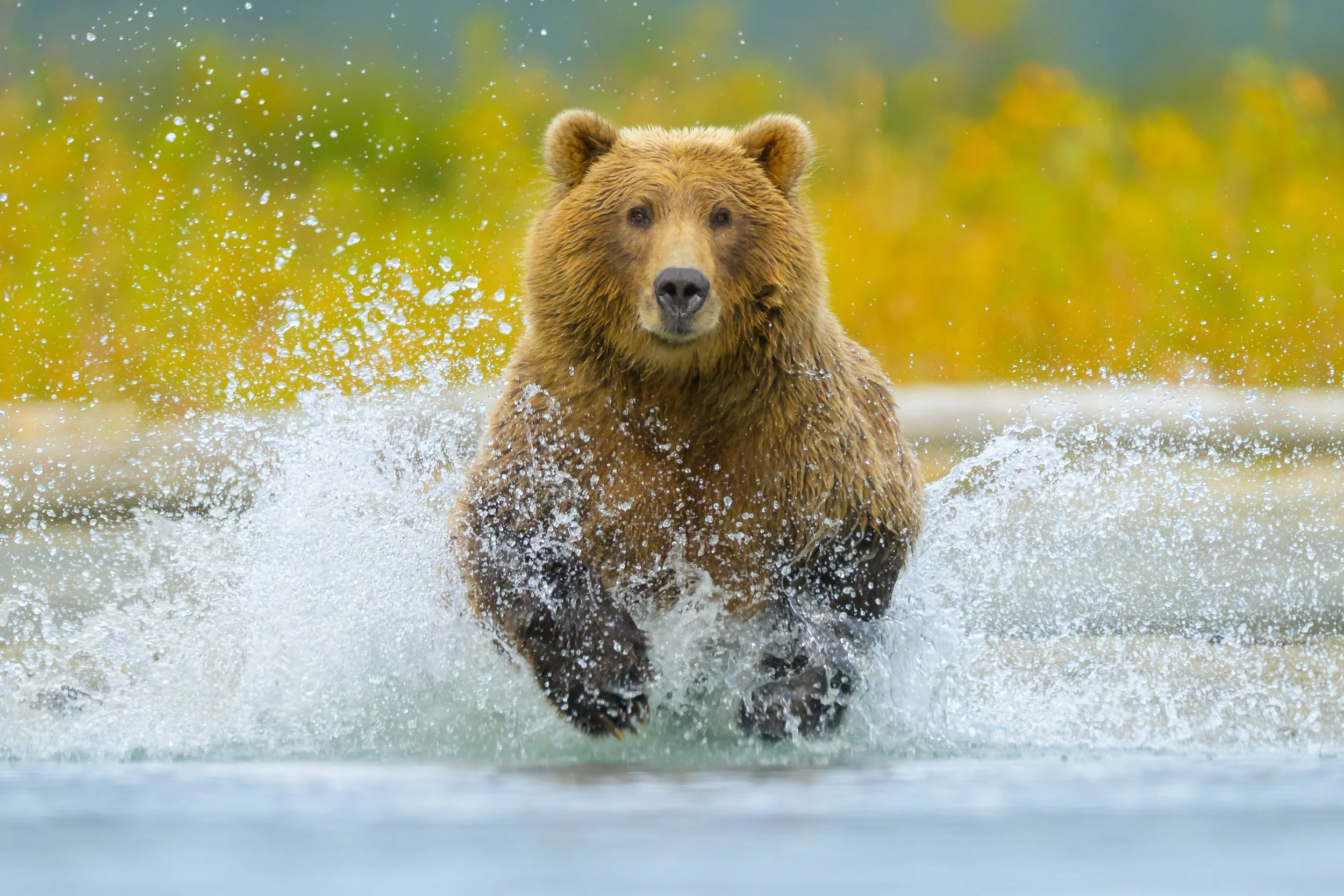
Not everything was perfect. This is adventure travel after all. Each year, nature throws her curve balls. But despite a drastically smaller sockeye salmon run than years past, a little tweak to our approach produced some of the best fishing opportunities I have seen come out of Alaska.
We began each of these workshops as we always do: a full day spent in a classroom setting talking shop. Autofocus area modes, low light photography, strategies for overcoming challenges we would face in the field, and most importantly, how we could use fieldcraft and a deeper understanding of brown bears and their food ecology to create the photos we wanted. These are workshops after all, not tours. And it was that understanding of food ecology that allowed us to make adjustments to the workshop in real time.
While the first workshop’s classroom session lasted all day, the second workshop’s class finished sooner than expected. With a few extra hours left in the day, we headed out to find and photograph loons nearby so folks could get used to being in their waders and working with their gear at water level. This side trip even rewarded us with a great gray owl set against the golden hues of paper birch.
With the classroom session behind us, the following morning we pulled on chest waders, boarded our floatplanes, and were sailing off through the clouds.
The flights left everyone speechless. The endless glaciers spilling out of the mountains like giant rivers of ice; the austere beauty of the peaks we slipped between; the towering stratovolcanoes that rise thousands of feet above the rest of the mountains perfectly spaced every 60km; ice fields that feel as though you have stepped back into the Pleistocene; the unmistakable line of footprints left by bears in the snow, making incursions into the high country to work on den sites that will soon be hearth and home to them for seven straight months. Everyone was glued to their windows.
And then there's the destination.
The natal sockeye lakes in the Alaska Range are nestled deep in the middle of everything we viewed from the air. Volcanoes standing sentinel, hanging glaciers spilling down from the icefields in the mountains and feeding these lakes where both sockeye and coho salmon return year after year to breed.
Thanks to the glaciers, the color of the water is an otherworldly blue. Think: Lake Louise in the Canadian Rockies; the product of glacial flour being ground down to a very specific size known as a colloidal particle.
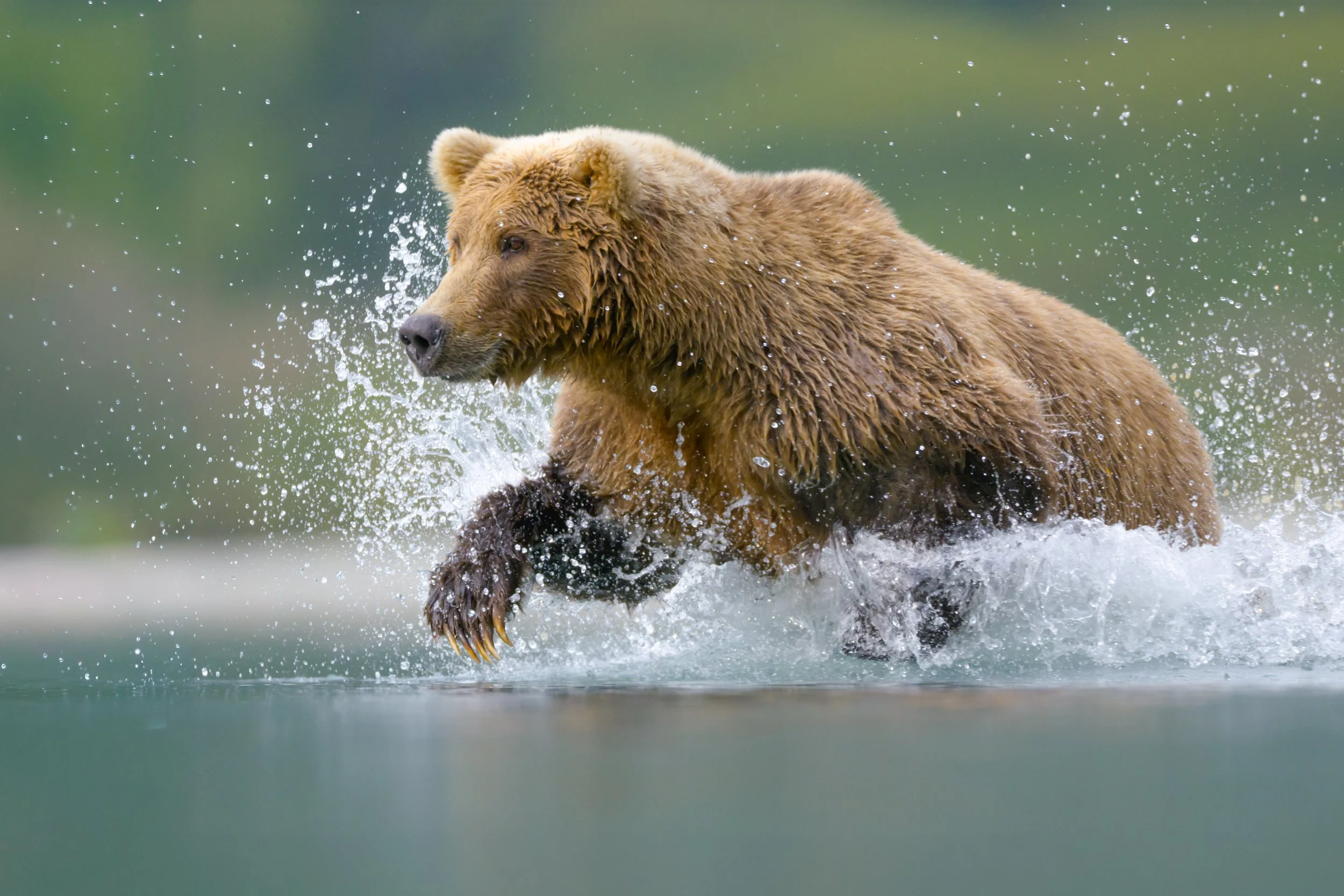
We use words like gravel and sand to describe the size of rocks. Nothing more. Colloidal particle is used the same way. Only, once rocks are pulverized down to this size, they reflect a milky blue color which gives glacial lakes and rivers a look that's more Caribbean than Alaskan.
Touching down on the water that first morning, we taxied to a spit of gravel. Climbing out onto the floats of the plane, we formed a fire line transferring gear from the tail to the beach before loading it into a couple small boats that had been strapped to the floats of the plane and flown in beforehand. A hundred yards away, a sow with two cubs worked the shoreline for neon red sockeye salmon.
This was a good omen for the coming weeks. And it meant that bears had returned to normal feeding behavior this year.
Last year, we arrived in the middle of a once in a decade super mast. A masting event is when various plants, be it nut producing trees or berry producing bushes, synchronize a massive explosion of seeds designed to overwhelm animals who would otherwise eat these things. And when this occurs, bears will walk away from rivers and lakes full of salmon to gorge themselves on blueberries, salmonberries, highbush cranberries, and red elderberries in Alaska.
I wrote an article about these masting events for PhotoWILD Magazine last Fall. While they completely chance the behavior of just about every animal you can imagine, they can be a windfall for wildlife photographers so long as you understand how to take advantage of them.
If you want to learn more about this, you can check out that article here: https://www.photowildmagazine.com/be-a-better-naturalist-super-masts
Bears need more this time of year than just protein. Studies looking at isotopes in brown bears show that in general their diet consists of 70% plants and 30% meat. But during hyperphagia, as their bodies have transformed into 24/7 eating machines, this ratio becomes much more nuanced and calibrated to survive hibernation.
Living through hibernation is a nutritional balancing act. Too little carbohydrates and fat, and a bear will likely freeze or starve to death. Too little protein, and a bear's muscles will atrophy, which means they will be too weak to hunt as soon as they come out of hibernation and starve to death. So, the whole thing is something of a Goldilocks scenario that comes in at around 19% protein and 81% carbs and fat.
Those are some very specific numbers. But surviving the winter up here comes down to some pretty extraordinary science.
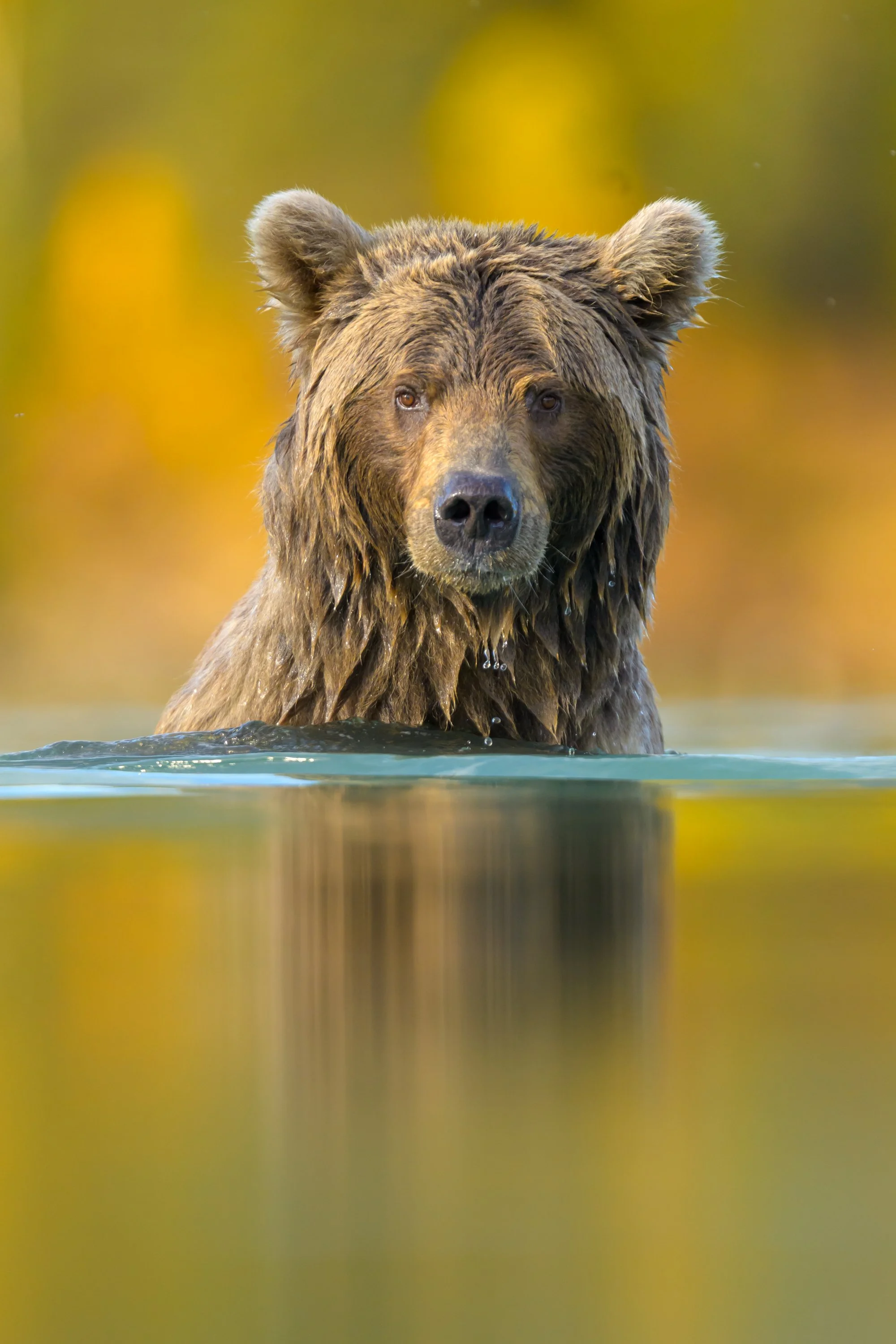
But what this means for us wildlife photographers this time of year is that bears are always moving back and forth between berry patches and salmon. And it's this balancing act that makes this location the perfect workshop destination.
Certain lakes function as if they were purpose built for feeding bears. In the ones we fly into, salmon are easy for the bears to catch. These glacially carved lakes are extremely deep, which pushes the spawning beds into a finite number of shallow areas along the edges of the lake. For bears, it’s not about the number of fish in a river or lake – it’s all about how easy it is to catch them.
But here’s where it starts to get interesting: the easier it is for bears to catch salmon in an area, the more berries that same area produces.
Since the salmon are easy to catch here, extraordinary numbers of salmon carcasses are dragged into the forest around the lake by the bears. When the living is easy, bears don’t eat the entire fish. Instead, they will eat the brains of the males and the eggs or roe of the females. Remember, it’s a delicate balance of protein to fat / carbs. When the salmon are running, protein is easy to come by. So, they target the stuff that’s not. And all these uneaten carcasses translate to metric tons of fertilizer dumped onto the forest floor each year.
In the forests surrounding the lakes and rivers where bears and salmon continue to play out their ancient ritual of predator and prey, studies have found the biomass to be 10 times greater than in forests without the salmon + bears combo. And as fertilizer goes up, as biomass increases, berry production explodes.
Anywhere from 4 to 8 different species of berries critical for brown bears begin to sweep across the landscape and up mountainsides. From the forest floor all the way up to the top of the surrounding peaks, the landscape is carpeted in berry producing plants that bears need.
But there's more.
All this fertilizer, all this increased biomass, all these berry bushes result in more insects. Researchers have also shown that insect abundance is 20 times greater around these prime fishing lakes where bears are actively fishing. Those insects are what feed the salmon fry for a year before they migrate to the ocean.
So, more insects in the area mean more salmon fry survive. The more salmon fry that survive, the more salmon return from the ocean in 3 to 4 years to keep the cycle going.
The result is a positive feedback loop. Over time, the food sources become extraordinary. Diversity begets diversity. Abundance begets abundance. And the population of bears here swells to a jaw dropping 4 per square mile this time of year as a result.
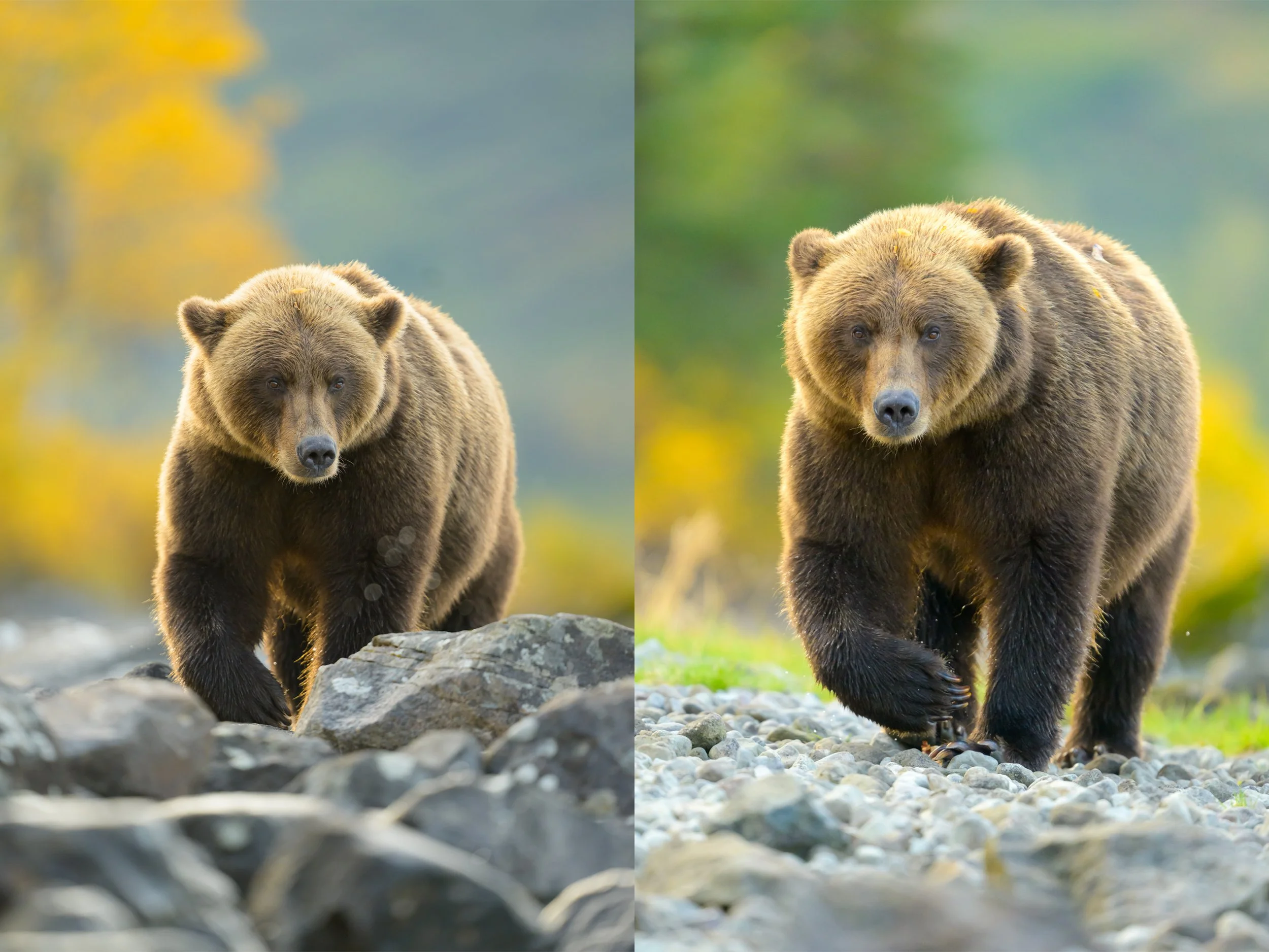
This year, however, the sockeye salmon run was abysmally small. We still saw a lot of these fish in the water, but the redds (the real name for a salmon spawning bed) were anemic compared to years past. And this had a measurable impact on bear behavior.
In typical years, some of the spawning beds were as predictable as Brooks Falls. Individual bears I have come to know over the years post up day after day in their favorite locations, slamming one salmon after another. But this year those beds were quiet and fishing bears were few and far between.
But that was just the sockeye.
In Alaska, we have 5 different species of salmon: chinook, chum, pink, sockeye, and coho. Much like the difference between black, brown, and polar bears, each of these species has its own unique natural history. They have their own lifestyles, their own preferences for spawning, the age at which they return, etc.
In many of the places where sockeye spawn, coho salmon also pass through on their way to the tangle of wetlands beyond the headwaters of the lakes to breed. While sockeye love their big deep lakes, coho prefer lily pad choked wetlands. And knowing this difference saved the day.
While there were still highbush cranberries and red elderberries around, this year's berry crop was nothing compared to the super masting event of the previous year. That meant bears were still gorging themselves on salmon to prepare for hibernation. And so, we needed only to change our approach to focus on locations where coho salmon would be funneled into the pinch points that allow bears to more easily hunt that species.
This is why understanding the full ecology of the species we photograph can be crucial for success. Recognizing the correlation between bears, berries, and salmon is important. But understanding how sockeye differ from coho in their breeding ecologies allowed us to adapt and create some of my all-time favorite fishing bear photos.
It was a 20-minute run by boat across open water, but the effort was worth it. Watching from a distance through my 10x42 binoculars as we approached, dark shapes soon became bears. Bears that were in the water. Bears that were actively hunting coho salmon.
Pulling up to an alluvial fan, we hopped over the side of the boats into the milky blue waters and planted ourselves in front of a sow with two cubs on the other side of the braid. Bears continued to materialize from the aether. And in short order, we had a total of 8 – all gathered in this one location for the same reason.
The sow we had set up for wandered back and forth on the bank in front of us. Her eyes scanning the water, her nose twitching as the most powerful sense of smell in the world analyzed us, the fish in the water, other bears both seen and unseen, before she finally set down on the bank directly in front of us. The background was a wash of gold from the willows at the edge of the wetlands beyond. It was a beautiful portrait, and we all trained our lenses on her at once – just seconds before she exploded off the bank in chase directly toward us.
Most chases in these situations last only a second or two. The bear explodes from the bank, makes a few dedicated leaps forward, and either pins down a fish or doesn’t. This wasn’t one of those situations. Instead, it turned into a full-blown chase.
She would lose the fish, bolt upright, towering above both us and river, only to launch again in the direction of the object of her desire. Water hung in the air all around her constantly. All the while, cameras rolled off 20-30 frames per second – second after second after glorious second.
I won’t repeat the expletives I heard around me. Just let it suffice to say everyone was beyond any attempt to contain their excitement.
As the paper birch, balsam poplars, and quaking aspens reach their peak colors for the fall, even the coho dwindle in numbers. By then, the cold has locked up the glaciers once again and water levels drop fast. The opportunity for fishing has passed. And bears all across these mountains turn to scavenging spawned out salmon and dead fish.
While fishing bears come with all of the heart stopping excitement of watching 800lbs of Ursus charge through the water toward your lens, I for one prefer the scavenging bears for my own photography.
This probably sounds a bit ironic. Why would I prefer bears wandering around scooping up dead fish to the excitement of the chase? But for me, we aren't just chasing bears. We're chasing photographs.
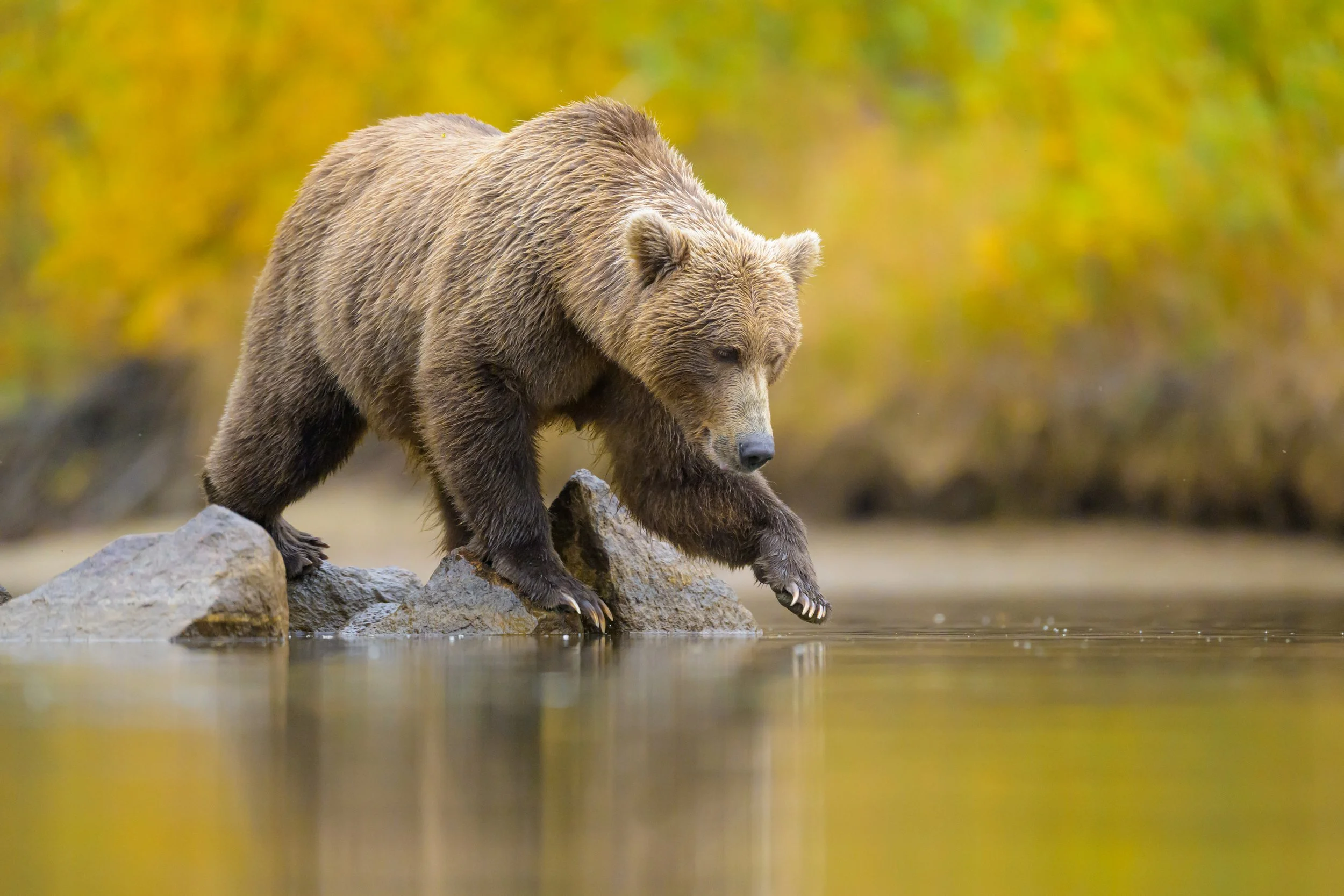
The opportunities that unfold with scavenging bears are what make late September so magical. Instead of fishing in one location, running into the water over and over again, bears are on the move. Bears are climbing out onto logs that function like strainers trapping dead fish drifting down with the current. Bears are crawling across rocks. Standing at the edge of the forest. Wading neck deep into the water. Snorkeling. Diving. And all the while backgrounds, foregrounds, and the landscape itself are changing constantly.
This is also happening at time when colors are at their peak. The backgrounds are a kaleidoscope of gold and orange hues. And the white stems of the paper birch, aspen, and balsam poplars juxtaposed against the color of the season are to die for.
It fascinates me to no end how life adapts. Three species of trees, all with white bark, growing in the same place, is not a coincidence. It’s an evolutionary adaptation to get a jump start on spring and photosynthesis.
All these trees have a thin green layer of chlorophyll rich tissue beneath that white bark. While the color white does reflect light, this bark plays double duty for the trees. Not only does it protect the tree from heating up too fast on a warm sunny day in the winter, only to refreeze at night causing its guts to explode and killing the tree, the white bark is so thin that light passes through it to the that green layer of cortex where it begins photosynthesis long before other trees are capable of doing so. This gives the trees a jump start on the season, allowing them to survive and thrive at the edge of what’s possible.
And in front of all this are the bears, a never-ending parade of Ursus arctos in the throes of hyperphagia trying to pack on as much fat as they can before wandering up north facing slopes to curl up for the long winter nap.
To me, these images scream wilderness. And it's the diversity, the ability to photograph bears in a hundred different settings instead of just one over and over again, that keeps me coming back to this place year after year.
Want to join us next year?
